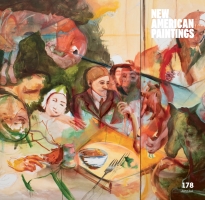
Tori Tinsley

My paintings and sculptures explore my changing relationship with myself and with my mother as she succumbs to a brain disease called fronto-temporal degeneration. Hugging bodies reveal the simultaneous enmeshment and separation that occurs in caring for her. Dark humor and the use of exaggerated facial features allow for the expression of the layered emotions experienced in such an ambiguous loss: despair, longing, disbelief, and even hope. This focus on myself is not meant to lessen the importance of my mother’s experience of the disease,

Kathleen Thum

In my drawings, paintings, and wall installations, I obsessively render a continuous line to create intertwined, tubular forms. As I draw, I consider the effect of how the transmission of fluids and gases, along with pressure and gravity, would influence these imagined forms. The forms are layered, and they loosely follow aspects of linear perspective to become networks that reference the vast and intricate transportation, processing, and refining systems of oil, natural gas, and water as seen in our industrial landscape.

Elise Thompson

My objects consist of dichotomies. Translucent textiles over wooden frames offer a delicate surface with an assertive support. Paint application is nuanced in some areas and clumsy in others, shifting back and forth between ethereal stains, loud color, and material textures. Shapes shift between the organic and the geometric, the nonrepresentational and the slightly familiar. Similar gestures take form in three-dimensional works that lean against walls or stand lightly on their own. Plywood, covered or left bare, is cut to evoke the abstract paintings, but also furniture

Barbara Campbell Thomas

I gather the pieces of my paintings through a series of habitual actions: 1. I fill sketchbooks with quick line drawings of words, objects, and patterns. I make the drawings while attending to tasks like making dinner, giving my son a bath, or writing a syllabus. 2. I tear off the front panels of cereal boxes, six-pack containers, and old birthday cards to use as material for an ongoing series of small, fast, early morning collages—my daily visual calisthenics.

Loring Taoka

My work is an extension or contemplation of the act of perception —lines of demarcation are only contextual. Exploring the space where the viewer simultaneously accepts two contradictory ideas provides the foundation. I use basic geometry as a point of departure, creating overlapping, incomplete, and illusory shapes in various stages of flux. Squares fade into squares; circles are completed in a two-way mirror’s reflection; a rectangle is created by smaller rectangles. The shapes visually weave in and out of each other, at once acknowledging and undoing their respective qualifiers.

Laurel Sucsy

I pay attention to the weight of color, to its material feel, to patches of pigment. The work is characterized by rhythmic arrangements of these patches. Layering creates depth and distance not through perspective but through accumulation of materials and textures. Incongruous color combinations—delicate, faded, or vibrant— oscillate. In painting, I am focused on the under-recognized haptic pleasures of perception. For me, painting is about holding time, delineating consciousness by spending moments looking. Transitions, where and how things meet, become a way of giving

Denise Stewart-Sanabria

My paintings are anthropomorphized Epicurean dramas staged across time and cultures. Traumatized baked goods and produce interact with random commercial tchochkes and props in staged interiors or edible landscapes. Backdrops are sourced from 400 years of wallpaper, fabric, painting, and graphic design.

Donna Ruff

What captures my attention as an artist are ordinary things, artifacts of lives lived and time passing: a folded newspaper, a mosaic tile, a frayed textile. I find visual patterns in these artifacts and re-create and expand on them in a slow, deliberate process that replicates aging and imperfection through cutting, burning, and layering. The paper I choose is essential to the result. I often work on preexisting media such as newspaper and books, cutting away some of the content, but I also use handmade paper to contrast my drawing with pure, white grounds. The intricate visual

Marc Ouellette

I refer to photographs for subject matter. The photographs come from a variety of sources, but are mostly my own. They are a starting point. They vary in subject matter, from people to farmyard animals, landscapes, and still lifes—whatever plays into my current concerns. In the paintings, the image is cropped, manipulated, reduced. Throughout the painting process, I might subtract or add elements, further tuning the composition.

Tim Kent

The two-dimensional picture plane of painting has shifted from a standardized formal element to a pattern of behavior. Through executing what is most important to my practice, I encourage the viewer to focus on the structure, where I use traditional canvas-building techniques. The majority of the formal elements are made during the canvas creation stage, before I ever put a brushstroke to the surface. The end result emphasizes sculptural forms and explores the parallel nature of painting and sculpture. A deep respect for craftsmanship manifests itself throughout

Pages