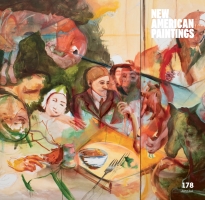
Inga Kimberly Brown

My recent works are oil paintings on sewn canvas panels and unsewn canvases on which a hybridization takes place through the implementation of three-dimensional objects that are either sewn on or attached with adhesive, threads, and paint, along with organic materials such as eggshells and holy water. I combine seed beads, faux grass, and 24-karat gold leaf, as well as oil on wooden extensions of the canvas. The work shows elements of ritual and tradition.

124


$30.00

Donald Martiny

“Donald Martiny’s bold pieces drew my attention for their unique visual impact, which owes partly to their scale, but also to their daring focus on a single pigment. Martiny’s work is pure; it is painting at its most elemental, composed of a single medium, a single gesture, a single colour. Martiny sits in a line of tradition from Malevich to Rodchenko through Newman and Stella. But, this is paint and painting laid bare, off the canvas, and uncomplicated by storyline, personality, politics or even historical context. In Martiny’s hands, paint becomes structural. As such, his work

Katrina Andry

Katrina Andry’s work explores the negative effects of stereotypes on the lives of minorities, and how these stereotypes give rise to biased laws and ideologies in the Western world. Her largescale prints—some as high as five feet—confront the viewer with these derogatory cultural clichés. The prints feature figures in watermelon/black face. They represent those who are targeted by racist characterizations. However, Andry specifically uses nonminority figures in this role to illustrate the fact that stereotypes are unjustly perpetuated. Stereotypes are based neither on truth

Colin Alexander

My painting practice lately seems to address the notion of theatricality in an art production operation, but is ultimately one facet of a larger, general practice. While the images always rely on the tool of representation (often of the mass-produced objects/ephemera that have woven themselves into the most intimate moments that might now constitute a personal history), the varying levels of commitment to depiction (or the sometimes stacked layers of imagery) nod toward a sense of self that frequently wavers.

Matthew Yaeger

My paintings resist the urge to sit still. Appearing direct and haptic, solid and precarious, compressed and energetic, my work exists at the meeting point of painting and idiosyncratic form, proposing questions of perception and categorization. A seemingly straightforward formal abstraction may also appear to be a letterform, a window, and ultimately a physical object that has a unique relationship to the space it occupies and the objects that surround it.

Michael Willett

My current body of work consists of mixed-media paintings created from an often indistinguishable combination of acrylic, screenprint, and collage on canvas. While reflecting on the broad history of abstraction, I’m interested in appropriation as an approach to nonobjectivism. Reproductions and advertisements of works by other artists are meticulously dissected and reconfigured into repetitive patterns and dense structures. Fragmentation, intricate layering, and the juxtaposition of textures and rhythms help produce these complex compositions. While my

Alex Waggoner

These paintings come from observations of landscape and architecture, but even more so from the spaces in-between. I focus on a forgotten pile of bricks, the way you can only see through a fence at just the right angle, the slow evolution of a construction site in its own grassless void, the privacy fence made of sheets of plywood leaning against a chain-link fence, and, how, meandering down a tiny side street, you can be pleasantly surprised that someone thought it a good idea to paint their stucco house, fence, shed doors, and cement wall all the same color, to turn it all into

Lance Turner

When we look at Manet’s A Bar at the Folies-Bergère, why don’t we see the viewer reflected in the mirror? This question inspired my interest in a painting’s ability to convey and distort multiple realities. I am concerned with a kind of imagery that is involved with framing experience. The narratives in my work incorporate viewers and their space as an extension of the space inside the painting. I do this by depicting spatial loops and by using parallel mirrors and other devices for representing infinity.

Dominic Terlizzi

My art is the synthetic colliding against history,
domestication, refinement, and germination,
nothingness, absence, place-holding, base,
origins of recipe, repetition, and memory,
hierarchy of beliefs in moments present,
class schema and academic structure,
authorship, authenticity, labor, origin,
transforming minutia into grandeur,
a found common object alphabet,
obfuscating a precise ending,
cosmic mosaic architecture,
retinal ground psychedelia.
acting without allegiance,
increments of exchange,

Pages